

Interoperability & Standardisation
Interoperability is the ability of vehicles, infrastructure and other road users to communicate and cooperate seamlessly, regardless of manufacturer, country or system implementation.
In Cooperative Intelligent Transport Systems (C-ITS), interoperability is essential to ensure that safety and traffic efficiency services function consistently across Europe.
Why interoperability matters
C-ITS involves a wide range of stakeholders and systems, including:
- vehicles (passenger cars, trucks, buses, PTWs and other road users)
- infrastructure systems operated by road authorities
- vulnerable road users and supporting devices
- backend and network services
Without a common approach to implementation, independently developed systems may interpret standards differently, leading to reduced compatibility and fragmented deployment.
Interoperability ensures that C-ITS services work reliably across all participating systems and borders.
The role of standardisation
European and international standards, developed by organisations such as ETSI, CEN and ISO, define the technical foundations of C-ITS, including:
- system architecture
- communication protocols
- message formats
- security mechanisms
- service definitions
These standards provide a common technical basis for implementation across Europe.
However, standards intentionally allow flexibility to support innovation, different deployment contexts and future evolution.
Why standards alone are not enough
Because standards include optional elements and implementation flexibility, different organisations may make different design choices when implementing the same standard.
This can result in:
- inconsistent system behaviour
- reduced interoperability between implementations
- challenges in cross-border deployment
- difficulties in large-scale system integration
To achieve interoperability in practice, additional coordination is required beyond standardisation.
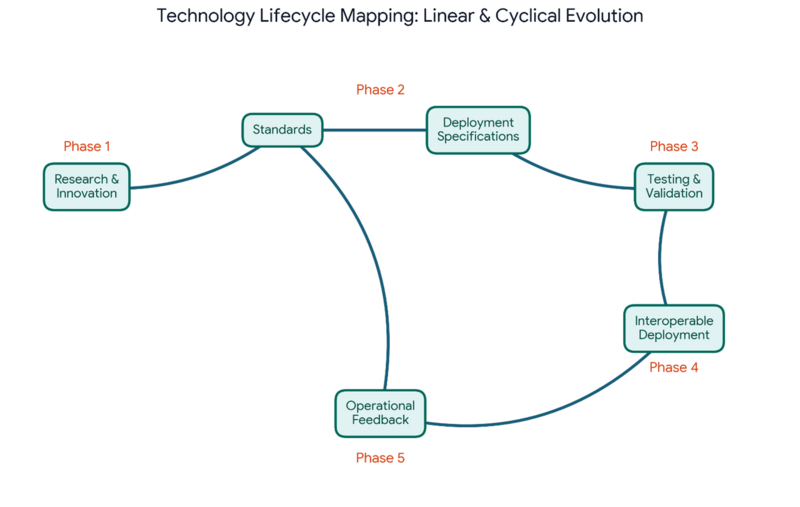
From standards to interoperable deployment
Interoperability in C-ITS is achieved through a structured approach combining:
1. Standards
Define what is technically possible.
2. Deployment specifications (BSP framework)
Define how standards are applied consistently to ensure interoperability.
3. Testing and validation
Ensure that implementations conform to specifications and work together in real-world conditions.
This combined approach enables scalable and reliable deployment of C-ITS across Europe.
The BSP framework as the interoperability mechanism
The Basic System Profile (BSP) is the core deployment specification framework developed by the CAR 2 CAR Communication Consortium.
It translates standards into consistent implementation rules by defining:
- implementation profiles
- interoperability profiles
- security implementation specifications
- test specifications
- domain-specific profiles
Together, these ensure that independently developed systems behave consistently in real-world deployment.
Relationship with infrastructure deployment (C-ROADS)
Interoperability requires coordination across both vehicle and infrastructure domains.
While the CAR 2 CAR Communication Consortium focuses on vehicle-side and cooperative system specifications, roadside infrastructure specifications are developed within the C-ROADS initiative.
Close collaboration between CAR 2 CAR and C-ROADS ensures alignment between vehicle and infrastructure implementations, enabling end-to-end interoperability across Europe.
The role of testing and validation
Testing is essential to ensure that standards and deployment specifications are correctly implemented.
Interoperability and conformance testing activities help to:
- validate compliance with BSP specifications
- verify correct system behaviour across implementations
- identify and resolve interoperability issues early
- support cross-border deployment readiness
These activities are a key part of the deployment lifecycle.
Continuous evolution
C-ITS interoperability is not static. It evolves continuously through:
- updates to European and international standards
- development of BSP deployment specifications
- feedback from testing and interoperability events
- operational experience from real-world deployment
- coordination with European policy and regulatory developments
This ensures that interoperability is maintained while enabling innovation and system evolution.
The role of the CAR 2 CAR Communication Consortium
The CAR 2 CAR Communication Consortium plays a central role in enabling interoperability in Europe by:
- developing and maintaining the BSP deployment specification framework
- defining implementation profiles for consistent system behaviour
- supporting interoperability and conformance testing
- coordinating alignment with infrastructure initiatives such as C-ROADS
- bridging the gap between standardisation and real-world deployment
Summary
Interoperability in C-ITS is achieved through a combination of:
- European and international standards
- BSP deployment specifications
- structured testing and validation
Together, these elements ensure that vehicles, infrastructure and other road users can communicate and cooperate seamlessly across Europe.